“There is no way I’m going into the Devil’s Museum until I have coffee,” I said to Rich. “Keep your eyes peeled for someplace — anyplace — that’s open.”
This was not looking likely. We were in Kaunas, Lithuania, which we’d chosen as a stopover on our roundabout way to Warsaw. The direct rail route would have taken us through Belarus, which required visas (and a taste for danger) we did not possess. Googling cities safely inside Lithuania, I came upon Kaunas and the city’s singular attraction that’s earned a spot on so many weirdest-in-the-world lists:
The Devils’ Museum
. That clinched it. Days later we were on Satan’s doorstep in a neighborhood devoid of coffee houses.
“So this is hell,” Rich said.
But wait! Two blocks away an open door beckoned.
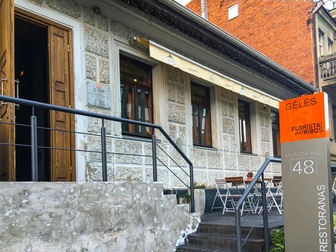
Putvinskio 48
turned out to be a cosmopolitan restaurant that was only too happy to provide us with foamy cappuccinos, slivers of apple pastry, and the translation services of the owner’s daughter, Diana, who happened by as we struggled to order. Clarification of the menu quickly morphed into a lively conversation ranging over her current veterinary studies in Ireland, things to see in Kaunas, and what to order when we returned that night for dinner.
The Devils’ Museum wasn’t nearly as convivial. The staff looked depressed and no wonder, surrounded by 3000 images of the Prince of Darkness, many of which will be showing up in my nightmares for years. The original collector was Antanas Žmuidzinavičius, an artist born on Halloween, 1876. By an odd coincidence, two friends marked his thirtieth name day with gifts of Beelzebub statues; one, a prominent priest, urged him to start collecting. Fifty years later Žmuidzinavičius owned 260 diabolical images, and friends presented him with thirteen place settings of custom-designed Satan-themed china. In 1961 he donated his collection to the State, and additions continue to pour in from fans of the Evil One and people wanting to divest themselves of demonic souvenirs that no longer seemed quite so amusing when they got them home.
That evening, we refreshed our spirits with a return visit to Putvinskio 48, where we enjoyed some of the best food we’ve had in the Baltic States.
But Kaunas is so much more than the Devils’ Museum and artistic beet soup. The next day we visited the
Atomic Bunker Museum
, located six meters below an old factory on the outskirts of town. We arrived to find a deserted industrial complex, an open door marked
Atominis Bunkeris,
and a very long stairway going down. We knew we were in the right place when we passed a banner that said, “Better be an informer for Trip Adviser than the KGB.”
Marius, our engaging young guide, waited in a vast underground room lined with Soviet paraphernalia and proceeded to describe each item with a collector’s enthusiasm. “This is the desk of KGB leader! Here is secret exit to tunnel; it ends near supermarket!” Various side rooms displayed cameras cunningly hidden in belts, handbags, cigarette packets, and coat buttons; plaster models of body parts showing the grisly effects of radiation poisoning; and the museum’s pride and joy, the gas mask collection. The tour was fascinating, and at the end of it, Marius gifted us with a gas mask.
“I love it,” I said, pulling it on. “Do you think it’s my color?”
“It really brings out your eyes,” Rich said.
Seeking another stopover on the next phase of our journey to Warsaw, I ran across a reference to the
Wolf’s Lair
in northern Poland. WWII buffs will remember this was the Eastern Front military headquarters where Hitler spent 800 days and narrowly survived an assassination attempt by one of his officers. Film buffs will remember that officer was played by Tom Cruise in Valkyrie.
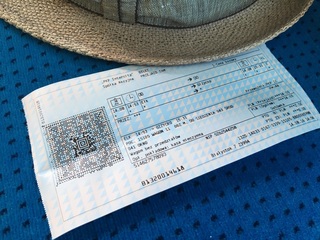
We made it! Our ticket from Elk to Giżycko.
Hitler chose the spot for its inaccessibility, and as we discovered, it is still one of the least convenient places to reach in all of Europe. It took Rich days to work out a route. We caught a train to Suwałki just across the Polish border, then a bus to Elk, a town famous for celebrating
Opposite Day
, in which everyone says the reverse of what’s true. This is supposed to occur January 30, but evidently they were willing to make an exception in our case. We had a tight connection, so we leapt off the bus and tore into the Elk train station, gasping, “Two tickets for Giżycko.” The clerk slowly wrote down a time three hours later. “Isn’t there one now?” She shook her head. A fellow passenger said, “Yes, there is one, but it leaves in one minute. You will never catch it.” Dashing down the stairs, we raced through the underground tunnel and stumbled up onto the platform just as the final whistle blew. We shouted incoherently at the conductor who, astonishingly, waved us on, taking out his radio and asking the engineer to hold up the train a moment. So that’s Elk: the best and worst stop ever.
From Giżycko, we took a train to the small town of Kętrzyn, where we hired a taxi to take us the last few kilometers. All I could think of, as we drove through the quaint villages, was that it was from these sweet, old, peaked-roof houses that the SS collected the fifteen terrified girls who served as
Hitler’s food tasters
at Wolf’s Lair. For 800 days they ate his food and waited to see if it had been poisoned. Afterwards, Margot Wölk recalls, “We used to cry like dogs because we were so glad to have survived.”
And that, I think, is why we visit places like the Devils’ Museum, the Atomic Bunker, and Wolf’s Lair: to remind ourselves that some of us, somehow, manage to survive even the darkest times. And that those times eventually end. Today, Wolf’s Lair lies in ruins, the colossal bunkers blown up by the Nazis as they fled before the Red Army in 1945.
So there Rich and I were, invading Hitler’s top secret hideout. Was it worth the fuss to get there? You bet. For one thing, you can’t help but have profound thoughts in a place where great evil has been perpetrated. For another, I somehow felt that all of us on that site were helping — as we say in California — to cleanse its aura. We brought normality into a place where it was once in very short supply. Every culture has exorcism rituals, and perhaps in this age of world travel, tourism offers a new way ordinary people can help banish the demons of the past.
Not to keep you in suspense, Rich and I have now arrived in Warsaw. To date we’ve
cover
ed 3420 km / 2125 miles
,
mostly by train.
Highlights have included zany
Amsterdam
, the German city of
Lübeck
on the edge of the Baltic Sea,
the Stockholm disaster
, the new foodie mecca of
Helsinki
, Finland, futuristic
Estonia
, and a kookie visit to
Riga
, Latvia. We
headed south to
Šiauliai, Lithuania
, where history — and great chocolate — were made.
Vilnius — and the tiny Republic of
Užupis
—
taught me about miracles.
To follow our adventures as they unfold,
subscribe to my blog
, like
my Facebook page
,
and keep checking
the
map of our journey
.
Leave a Reply