It’s the most wonderful time of the year for word nerds like me, because all the major dictionaries are announcing the weird and wonderful slang terms that have stopped hiding out in the dark corners of human speech and are finding their way into the light of everyday use. Some will soon slither off back into obscurity while a lucky few will one day be crowned “word of the year.” It’s heady stuff.

For those of us who love to travel, some delightful newcomers include — I’ll pause here so you can run fetch a notebook and pen to jot these down — hushpitality (caring for guests in a calm, Zen-like atmosphere), bookbound (journeys inspired by literature), side-questing (rambling around with no fixed itinerary), and my favorite, the why-cation (heading out purposefully).
When it comes to travel with a purpose, it’s hard to outshine the ancient Romans, who set off determined to conquer the world and managed to assert heggie (dominance or hegemony) over a remarkably large percentage of it. They got around to what’s now Spain in 218 BC and stayed for nearly 700 years. Their imprint is everywhere, and nowhere does it shine more vividly than in Itálica, just eight miles from Seville. Built to house wounded veterans and control a vital port, it grew into one of the richest and most powerful cities in the Roman Empire.
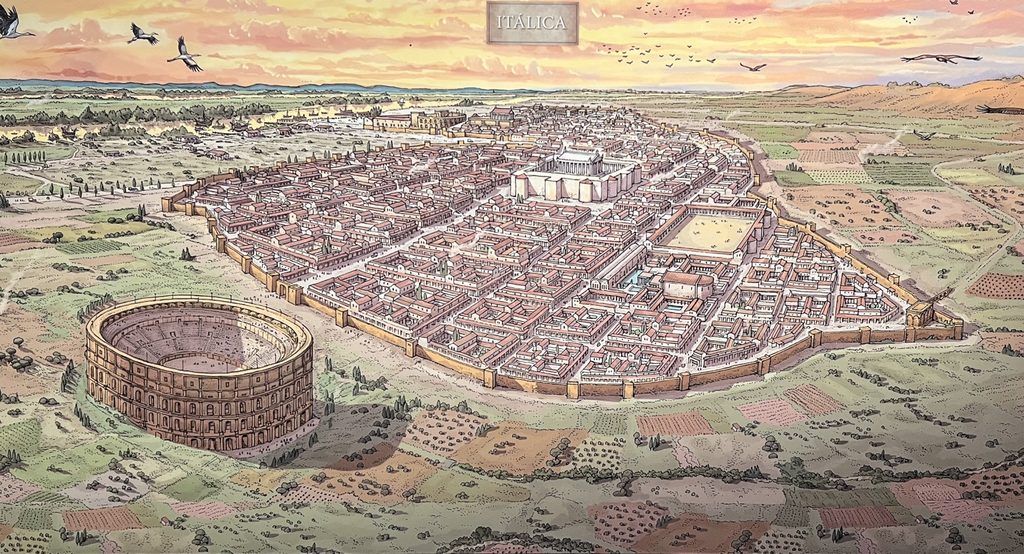
Conjunto Arqueológico de Itálica
Even now, reduced to crumbling ruins, Italica is amazing, thanks to those long-ago homeowners who threw themselves into what is now called mogging (upstaging everyone else) and aura farming (deliberately styling your surroundings to show how effortlessly cool you are). The stubs of old stone walls reveal sprawling private homes with elaborate gardens and gorgeous tile floors, making it clear these Romans had a full-blown edifice complex.
This week Rich and I headed out to Itálica on a bus (for which, unsurprisingly, there is no new, hip slang term) that dropped us at the gates of the old city, in what’s now the suburb of Santiponce.
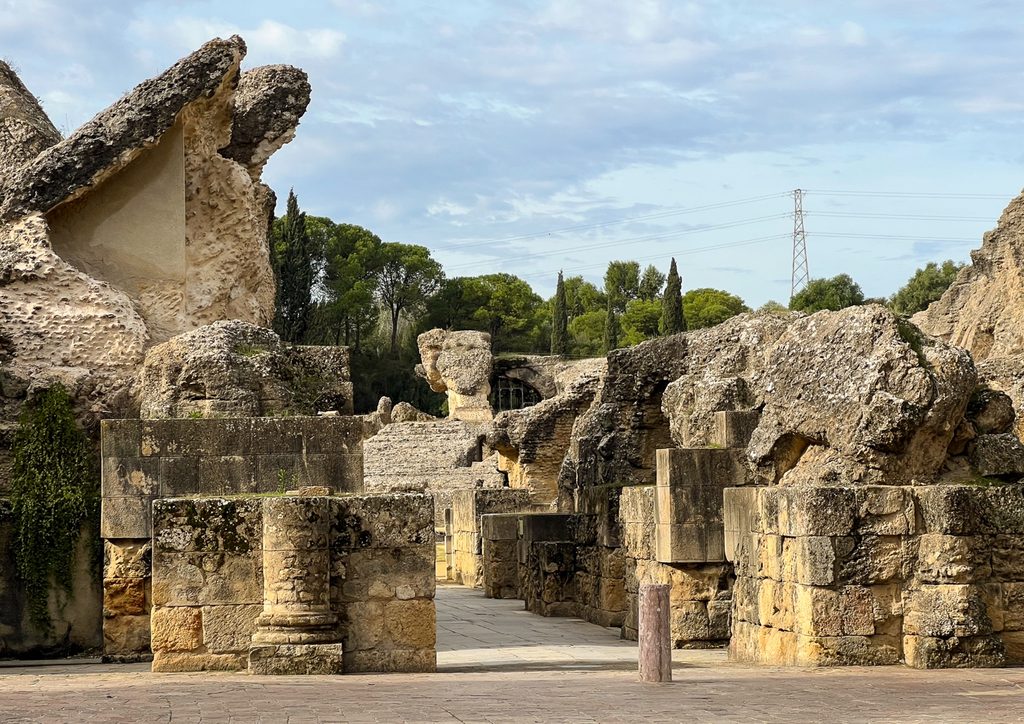
Whenever I visit Itálica, I find it remarkably soothing and peaceful after the vibrant bustle of Seville. There’s something about looking at the tumbled-down remnants of a former superpower’s stronghold that puts things in perspective. A reminder that even the most powerful oppressors don’t last forever.
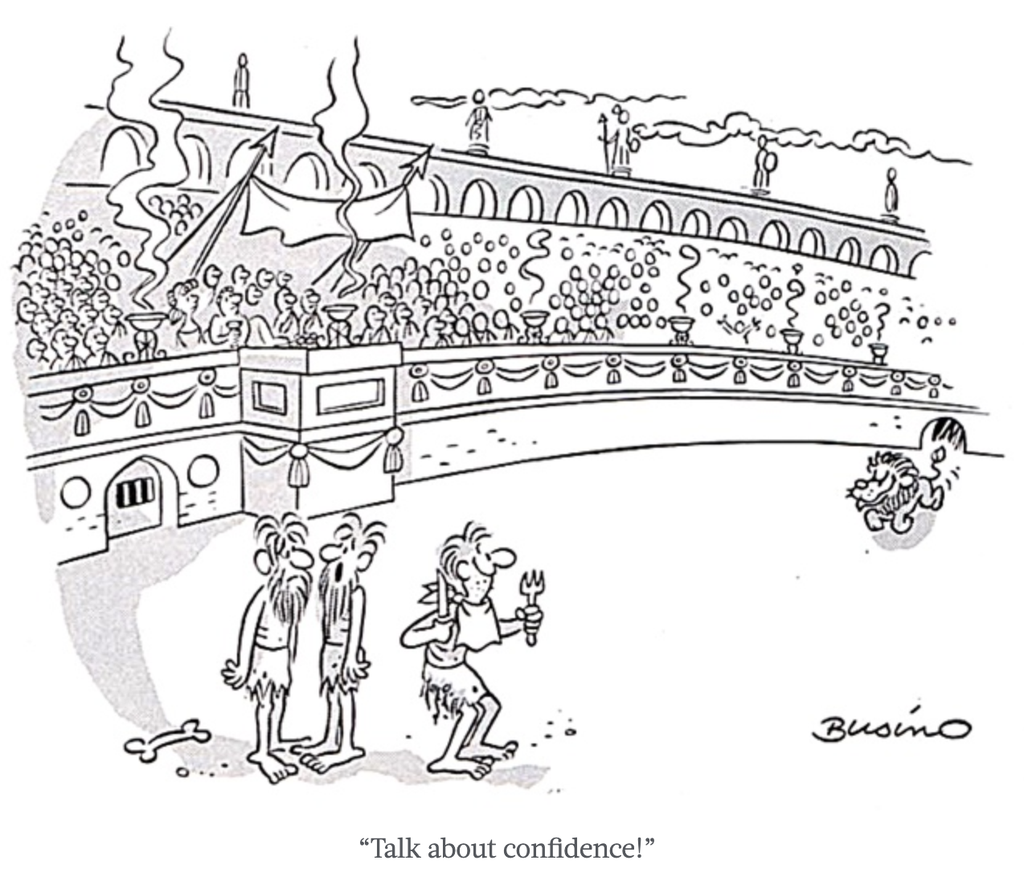
Having recombobulated ourselves with some brain juice (coffee) at a nearby café, we strolled into Italica and at once found ourselves at the very best part: the massive amphitheater. The Romans, who invented the phrase “bread and circuses,” wisely fed their populace and offered lavish entertainment to keep everyone distracted from whatever pesky little political concerns might arise. Itálica’s amphitheater was the second largest in the Roman Empire, holding 25,000 fans, and the gladiatorial spectacles were full-on gorecore for men and beasts.
Game of Thrones fans will recognize Italica’s amphitheater as the Dragonpit in the scene where Daenerys Targaryen rode in on one of her fire-breathing, carnivorous reptiles. When it comes to making a dramatic entrance, she reset the bar for all time — or as we say in 2026, she ate and left no crumbs. Visitors who come to goggle at the location because they loved the show are indulging in a form of tourism now called set-jetting.
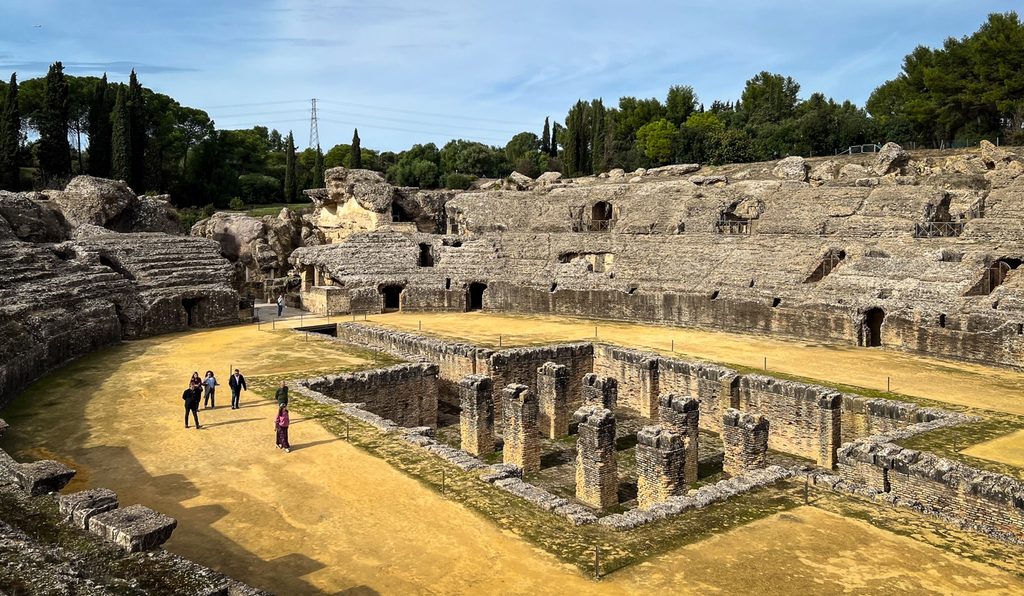
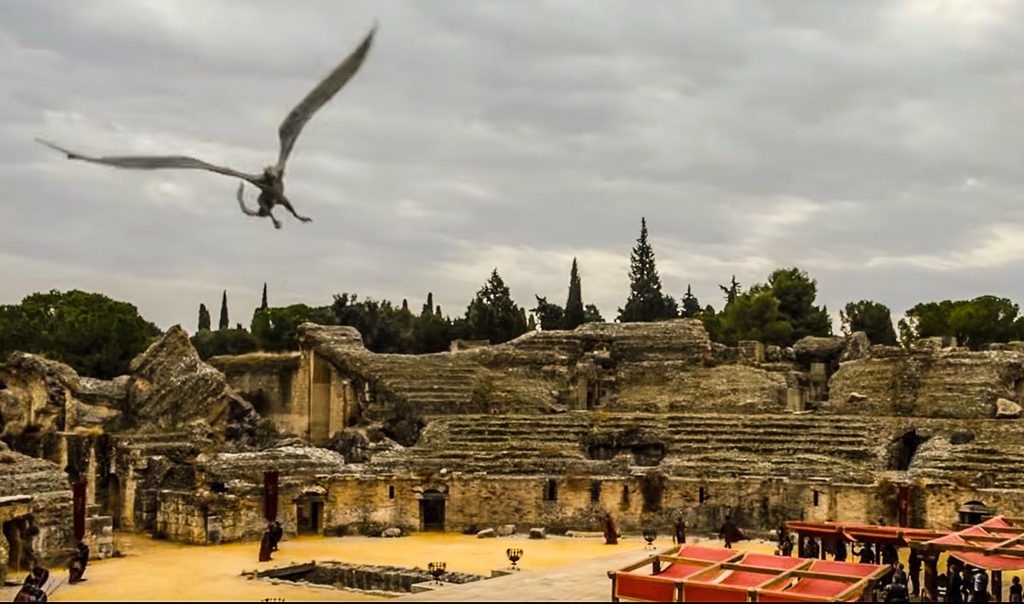
From the amphitheater, a broad ceremonial avenue leads into the town proper, and Rich and I spent a happy hour wandering the ancient streets, spotting newly repaired mosaics and enjoying old favorites such as the House of Neptune and the Palace of the Birds.
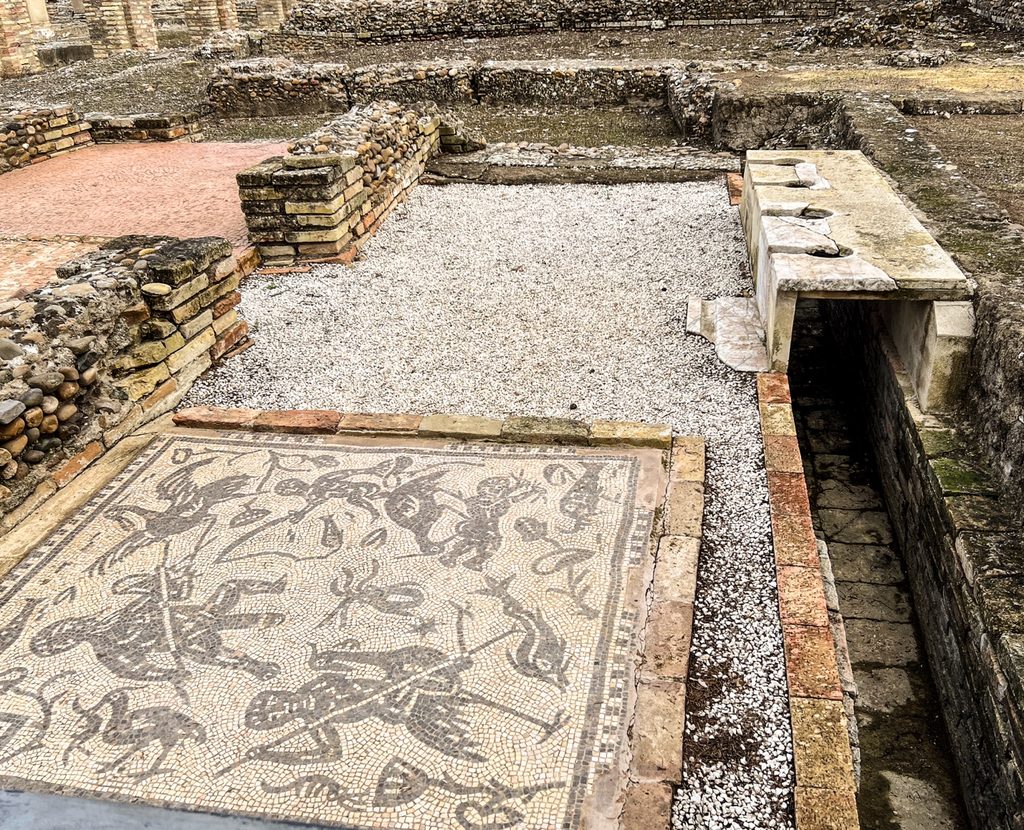
I had to admire the sophisticated engineering that went into the 2000-year-old public latrine, which included running water under the toilets. The mosaic showing pigmies fighting cranes was a favorite motif in such settings, taken from a line in The Iliad and intended to provide a note of slapstick humor, as laughter was believed to fight off the demons known to haunt latrines. (Today, of course, we call them germs and fight them off with hand sanitizer.)
By 460 AD, the Romans were gone and the local citizens, realizing that Itálica was an irreplaceable part of the patrimony of humanity, meticulously preserved the site. Yes, of course I’m kidding; the looting began at once, with everyone carting off stones as fast as they could carry them, using them to shore up their own houses and latrines. In 1740 the city of Seville tore down the upper walls of the amphitheater to build a dam on the Guadalquivir River. The luxurious houses went for a road project. Jesus wept.
There would likely be nothing left at all if Napoleonic troops hadn’t occupied the region in 1810. Horrified by the destruction, they started passing laws and, more importantly, allocating funds for preservation. By the late nineteenth century, many treasures were in the Archaeological Museum of Seville. Sadly, however, you cannot go see them because the museum closed in 2020 for a three-year renovation that’s now predicted to last until at least 2029. Possibly 2039.
But inevitably, many of the ancient treasures wound up in private collections, most spectacularly and controversially, in the palace of the Countess of Lebrija.
Regla Manjón Mergelina, Countess of Lebrija, was a vastly wealthy patron of the arts, amateur archaeologist, and collector of antiquities in the days when the laws regarding such purchases were very loose indeed. In 1901 she bought a fifteenth-century palace in the heart of Seville and decided what her decorating scheme needed was a bunch of those cool Roman mosaic floors from Itálica. And here the details become murky…
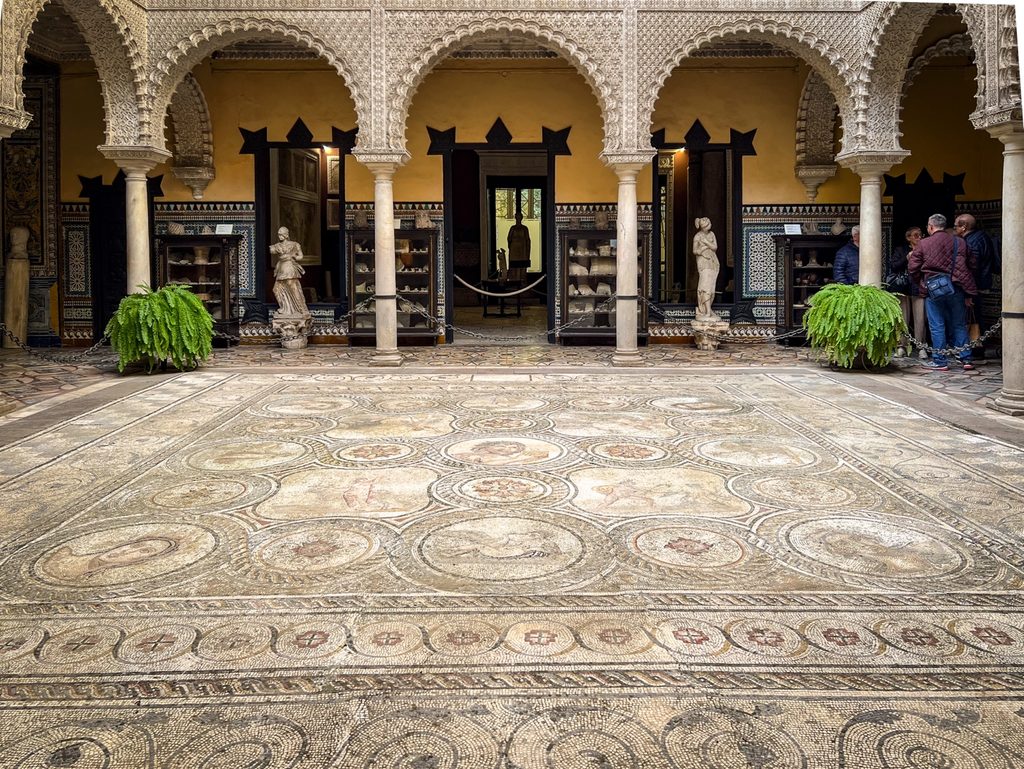
In 1999 her heirs moved out of the palace and turned it into a museum, reserving the right to drop by every Christmas for a meal in the formal dining room. For the rest of the year, anyone willing to fork over 15 euros ($16.37) can see the splendid Roman floors, marble busts, pottery, and other loot — I mean, artifacts — the countess acquired from Itálica.
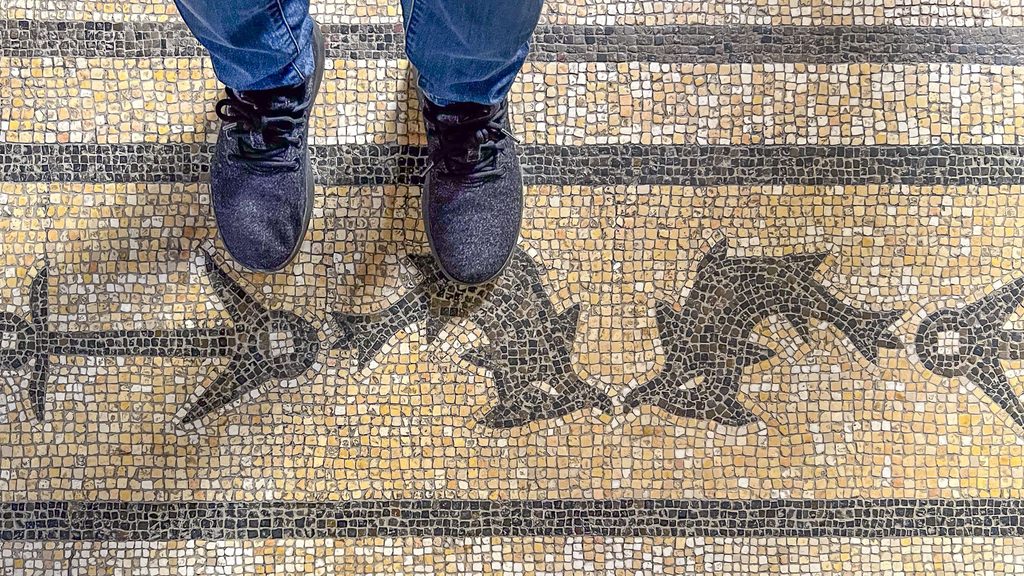
And I have to say, it is a pleasure to see the floors as they were meant to be: more or less intact and placed properly for everyday use. The museum keeps them roped off, but in a few spots along the edges you actually have to walk on ancient Roman mosaic tiles to pass through the room. Is this a sacrilege — or a rare privilege, being able literally to tread in the footsteps of the ancient Romans? You be the judge.
How do you plan to spend 2027? Mogging and imagemaxxing like an ancient Roman or in goblin mode (unapologetically self-indulgent, messy, refusing to curate your self-image)? Taking bold why-cations or cozymaxxing at home? “The happiness of your life depends upon the quality of your thoughts,” said wise old Roman Emperor Marcus Aurelius. “When you arise in the morning, think of what a precious privilege it is to be alive — to breathe, to think, to enjoy, to love.” Wisdom worth preserving for the ages to come.
You might also enjoy…
Leave a Reply